You wash your yogurt cup.
You separate the plastic bottle.
You throw it in the blue bin with a clear conscience.
You believe you are saving the planet.
But what if I told you that 91% of that plastic will never be recycled?
What if the recycling symbol itself was a marketing invention designed to make you buy more?
This is the Plastic Recycling Myth.
🛢️ Detective’s Briefing: Big Oil’s Plan B
- The Symbol Scam: The “chasing arrows” triangle on plastic doesn’t mean “Recyclable.” It was created by oil lobbyists in 1989 to trick consumers into feeling guilt-free.
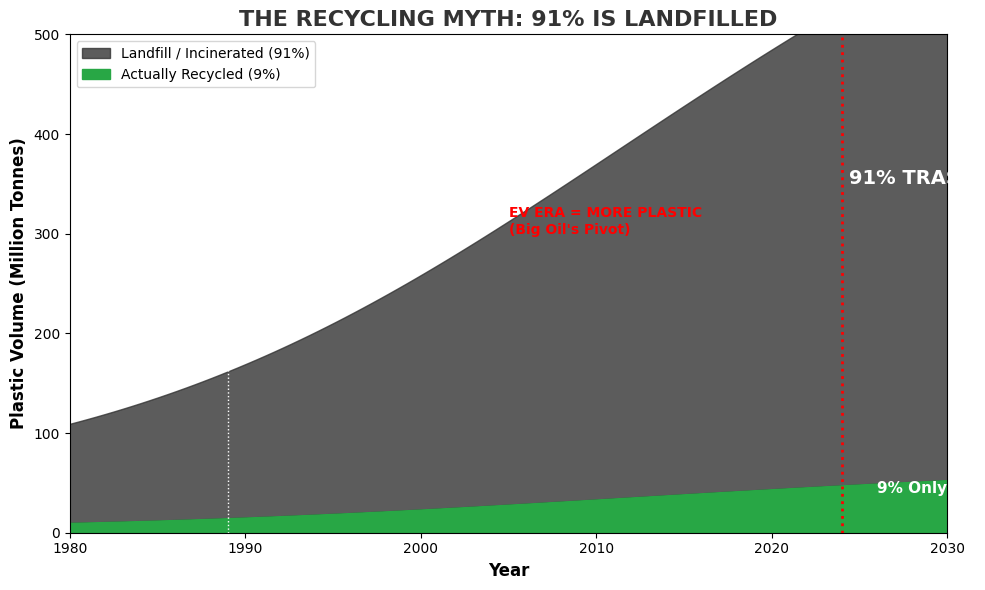
- The 9% Reality: Since 1950, only 9% of all plastic has been recycled. The rest is buried or burned. Most “recycling” is actually “Downcycling” (making lower-quality trash).
- The Pivot: As Electric Vehicles (EVs) kill fuel demand, Big Oil (Exxon, Shell) is pivoting to plastic. Plastic is their “Plan B” to keep selling oil.
In this investigation, we expose the lie behind the blue bin and why smart investors are betting on the company that buries the truth: Waste Management ($WM).
The Symbol Scam: It Was Never About Recycling
Look at the bottom of a plastic container. You see the triangle with a number inside. You assume it means, “This can be recycled.”
It doesn’t.
That symbol is the Resin Identification Code. It was introduced in 1989 not by environmentalists, but by the Society of the Plastics Industry (lobbyists).
Its only purpose is to identify the type of plastic. It is a brilliant psychological trick. By putting a “recycling-ish” symbol on everything, they removed the consumer’s guilt, allowing them to sell more single-use plastic.
The 9% Truth: Downcycling into the Grave
The numbers are damning. Since mass production began, the Plastic Recycling Myth has hidden a dirty secret: 91% is trash.
The Trap of “Downcycling”
Even the 9% that gets “recycled” rarely becomes a new bottle. It gets “downcycled” into lower-quality items like carpet or park benches.
What happens when that carpet gets old? It cannot be recycled again. It goes to the landfill. Recycling simply delays the trash’s journey to the grave by a few years.
Big Oil’s Plan B: Why Production is Exploding
If the world is drowning in plastic, why are companies making more?
Because of Electric Vehicles (EVs).
Giants like ExxonMobil and Shell know the end of the combustion engine is coming. Demand for gasoline will crash. They need a new way to sell their oil.
Plastic is solid oil.
By shifting refineries to produce petrochemicals for plastics, they secure their survival. They need the Plastic Recycling Myth to fail. If we actually recycled plastic, we wouldn’t need to buy their “new” plastic (oil).
The Detective’s Verdict: Bet on the Landfill
The recycling system is broken by design. So, where does the smart money go?
It goes to the company that owns the final destination.
📊 The “Trash Monopoly” Play
| Ticker | Company | The Logic |
|---|---|---|
| $WM | Waste Management | They own the landfills. When recycling fails, cities pay WM a “tipping fee” to bury the plastic. They profit from the failure. |
| $XOM | ExxonMobil | (Hedge) Betting that plastic demand will continue to rise as the “Plan B” for oil. |
REALITY CHECK
Don’t invest in the fantasy of a circular economy. Invest in the reality of a linear one.
Plastic isn’t going away. It’s going into the ground. Make sure you own the ground.