
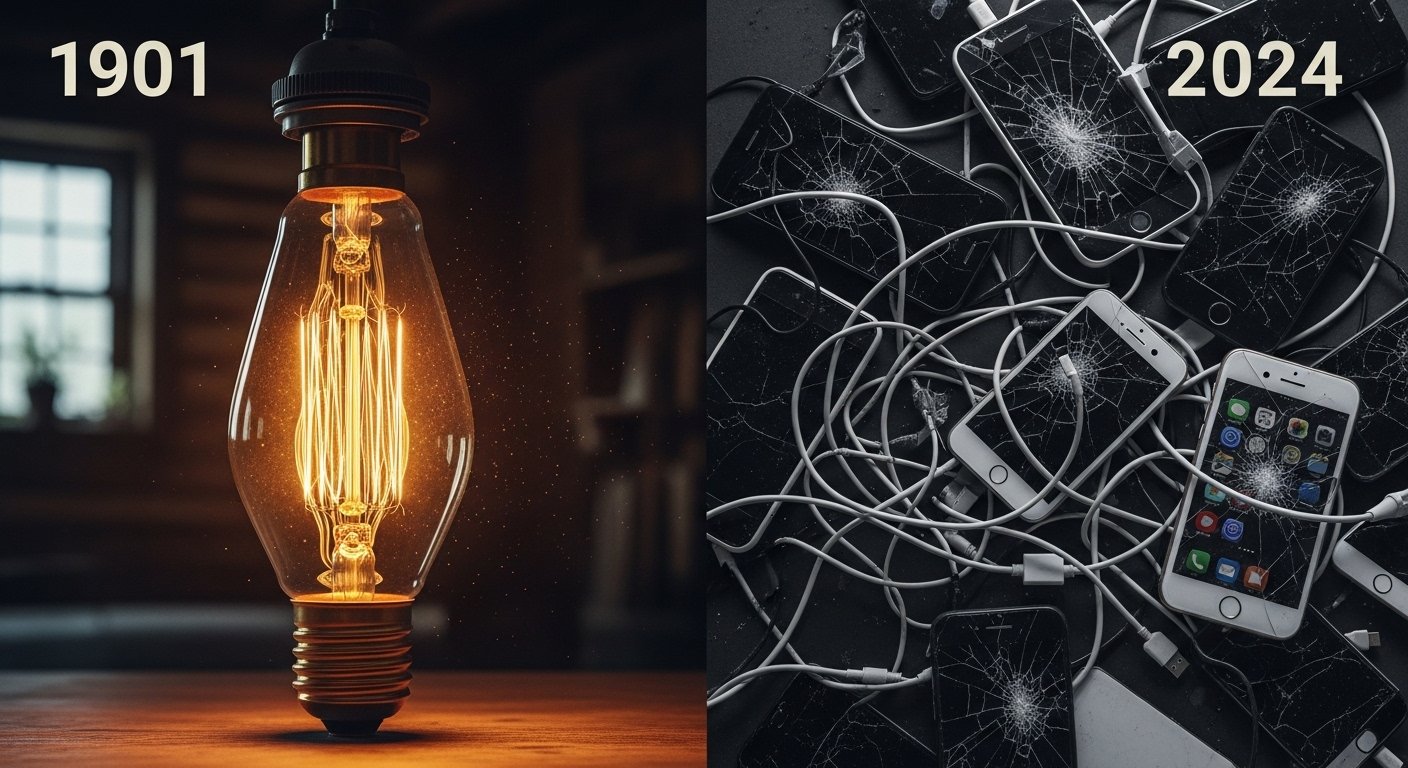
Have you ever wondered why your grandmother’s refrigerator lasted 30 years, but your new one breaks in five?
Or why your iPhone suddenly slows down the moment a new model is released?
It’s not bad luck.
It’s not a lack of technology.
It is a carefully engineered strategy called “Planned Obsolescence.“
Corporations are designing products to die, so you are forced to buy them again.
🗑️ Detective’s Briefing: The Trash Economy
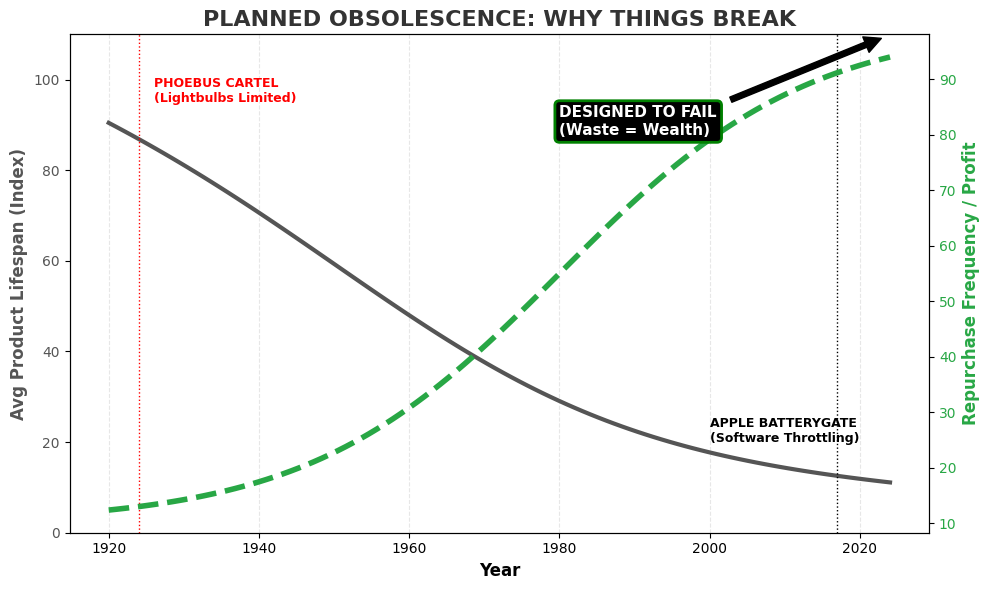
- The Origin: In the 1920s, the “Phoebus Cartel” secretly agreed to reduce lightbulb lifespans from 2,500 hours to 1,000 hours. It was the first conspiracy against durability.
- The Modern Crime: From Apple’s “Batterygate” to glued-shut AirPods. Tech giants now use software and adhesives to ensure you cannot repair your devices.
- The Investment: If the world is drowning in intentional trash, who wins? The trash collector. **Waste Management ($WM)** is the ultimate hedge against this cycle.
This isn’t a conspiracy theory. It is a documented business model. In this file, we trace the history of **Planned Obsolescence** and reveal how smart investors are turning this mountain of garbage into gold.
The Origin: When Innovation Was Killed
The story begins with a lightbulb and a pair of stockings.
The Phoebus Cartel (1924)
In Geneva, the world’s biggest lightbulb makers (Philips, Osram, GE) met in secret. They had a problem: their bulbs lasted too long. If a bulb lasts forever, you never buy another one.
So, they signed an agreement to limit the lifespan of all bulbs to 1,000 hours. Any factory producing longer-lasting bulbs was fined. They engineered fragility to guarantee profit.
The Nylon Tragedy
In the 1940s, DuPont invented Nylon. It was a miracle material—strong as steel. The first nylon stockings were virtually indestructible.
But DuPont realized: “If they don’t rip, women won’t buy more.” They ordered their chemists to weaken the formula. The fragile, easily torn stockings we have today are the result of sabotaging innovation.
The Modern Crime: Software and Glue
Today, **Planned Obsolescence** has gone digital.
Apple’s Batterygate
In 2017, Apple admitted to slowing down older iPhones via software updates. They claimed it was to “protect the battery,” but users felt forced to upgrade. Apple eventually paid $500 million to settle the lawsuit.
The AirPod Trap
Wireless earbuds are the ultimate example of “Disposable Luxury.” They are sealed with powerful glue. You cannot open them. You cannot change the battery.
When the battery dies in 18-24 months, the device becomes e-waste. It is designed to be thrown away, not fixed.
The Economic Logic: Waste is Wealth
Why do they do it? Because our economy depends on it.
If products lasted forever, factories would close, GDP would shrink, and stocks would crash. **Planned Obsolescence** is the engine of modern consumerism. It turns citizens into consumers who are on a permanent treadmill of buying, breaking, and buying again.
The Detective’s Verdict: Invest in the Trash
As a consumer, this is frustrating. As an investor, it is an opportunity.
If companies are determined to create mountains of electronic waste, the smartest play is to own the company that cleans it up.
📊 The “Trash is Cash” Strategy
| Ticker | Company | Why Invest? |
|---|---|---|
| $WM | Waste Management | The undisputed king of trash in North America. They own the landfills. It’s a monopoly on garbage. |
| $RSG | Republic Services | The #2 player. A favorite of Bill Gates (Cascade Investment). Safe, boring, and profitable. |
| $AAPL | Apple | (Controversial) If they keep forcing upgrades, their revenue grows. Betting on the villain is also a strategy. |
ONE MAN’S TRASH…
Tech companies create the problem ($AAPL). Waste companies solve it ($WM).
While others complain about their broken phones, you can collect the dividends from their disposal.