Asking yourself “is a master’s degree worth it” can feel immense, especially when you scroll through LinkedIn and see “MBA Candidate” or “M.S. in Data Science” everywhere. It feels like the new standard. But then you look at the price tag and… wow. Is taking on another mountain of student debt actually going to pay off, or is it just an expensive piece of paper? I get it. It’s a huge, stressful decision that can feel like a gamble. This post is here to help you move from anxious guessing to a clear, data-driven decision. Let’s break it down together! 😊
The True Cost of a Master’s Degree 🤔
First, we need to talk about the real cost. It’s not just the tuition bill you get from the university. The sticker price is just the beginning. The biggest, often-overlooked factor is something economists call Opportunity Cost. This is the salary you’re *giving up* by being in a classroom instead of in the workforce.
If you’re making, say, $65,000 a year and you leave your job for a two-year Master’s program, that’s $130,000 in lost earnings. When you add that to the cost of tuition (which can easily be $40,000-$80,000 or more), the total investment gets very serious, very fast. This is the “cost” part of our cost-benefit analysis.
Remember to factor in living expenses, books, fees, and interest on student loans. These can add another $20,000-$30,000 per year to your total cost, depending on your location and lifestyle.
The “Master’s Premium”: Analyzing the Payoff 📊
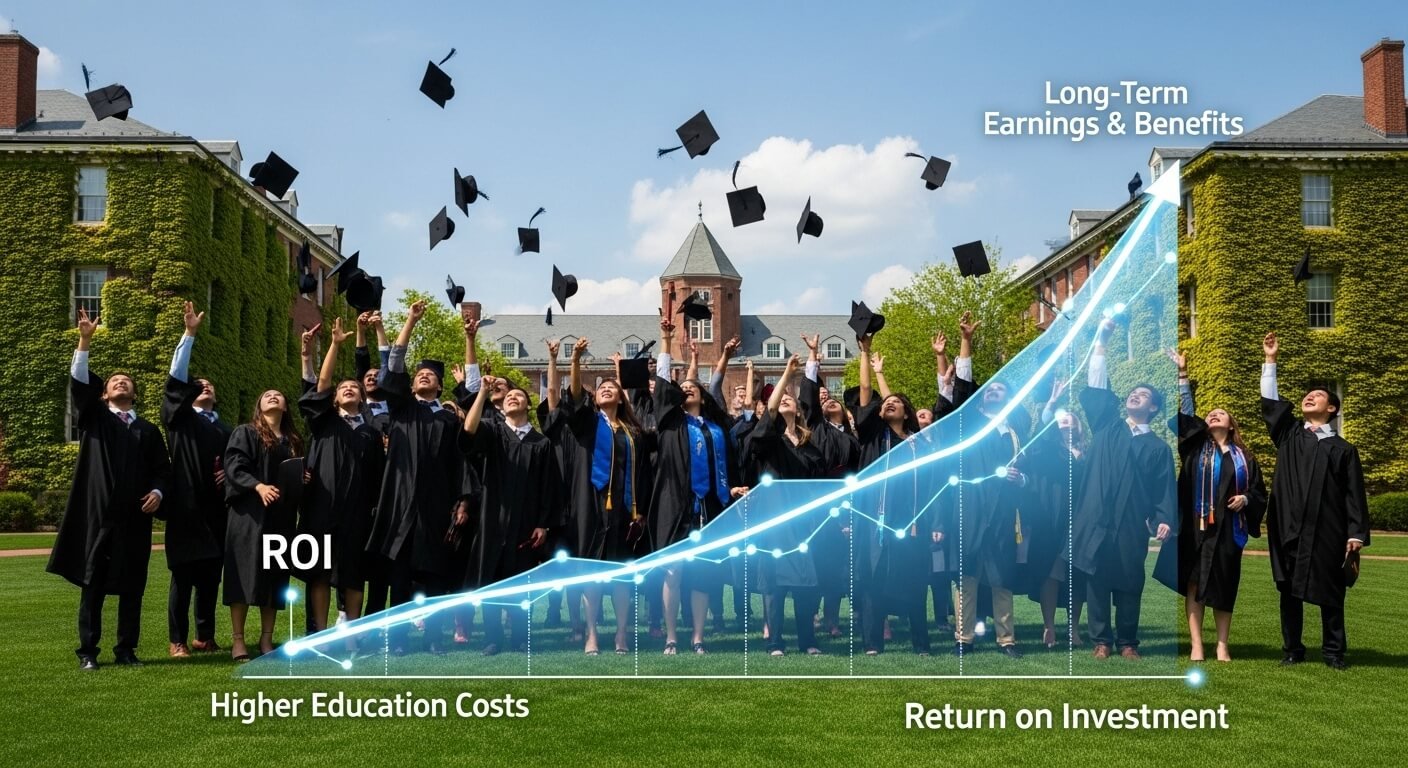
Okay, so the costs are high. But what about the benefits? The main financial argument for a Master’s is the “wage premium”—the extra money you can expect to earn over your career compared to someone with just a Bachelor’s degree. This boost to your lifetime earnings is the key to a positive ROI.
However, this premium varies wildly by field. A Master’s in social work won’t have the same financial payoff as an MBA from a top-tier school. It’s crucial to look at data for your specific field of interest.
Salary Comparison: Bachelor’s vs. Master’s (Median Mid-Career)
| Field of Study | Bachelor’s Median Salary | Master’s Median Salary | Annual Premium |
|---|---|---|---|
| Computer Science | $110,000 | $135,000 | +$25,000 |
| Business Administration (MBA) | $85,000 | $125,000 | +$40,000 |
| Education | $58,000 | $70,000 | +$12,000 |
| Nursing (MSN) | $80,000 (BSN) | $115,000 (NP) | +$35,000 |
These are just averages! Your actual salary will depend on your location, experience, negotiation skills, and the reputation of your university. Use these as a starting point for your own research, not as a guarantee.
Calculate Your Personal Degree ROI 🧮
Now it’s time to put it all together. A simple way to think about the return on investment is to compare the total costs against the total lifetime gains. Let’s make it practical with a simple calculator.
📝 The Basic ROI Formula
ROI (%) = ( (Lifetime Earnings Gain – Total Cost) / Total Cost ) * 100
Use the tool below to get an estimate for your own situation:
🔢 Master’s Degree ROI Calculator
Beyond the Paycheck: Intangible Benefits 👩💼👨💻
A Master’s degree isn’t just a financial calculation. For many, the biggest benefits aren’t captured in an ROI percentage. You’re building a professional network, gaining specialized skills that make you more adaptable to career changes, and often achieving a higher level of job satisfaction. These things are hard to quantify but can be incredibly valuable.
- Professional Network: Access to alumni, professors, and classmates.
- Career Pivot: The credibility to switch into a new industry.
- Personal Growth: Developing critical thinking and discipline.
Case Study: Alex and the Data Science Master’s 📚
Let’s make this real. Meet Alex, a marketing analyst who wants to pivot into a more technical data science role. Is a Master’s degree the right move?
Alex’s Situation
- Current Salary: $70,000/year
- Program Details: 2-year M.S. in Data Science
- Total Tuition & Fees: $60,000
- Expected Salary Post-Degree: $110,000/year
The Calculation
1) Opportunity Cost: $70,000/year * 2 years = $140,000
2) Total Cost: $60,000 (Tuition) + $140,000 (Opportunity Cost) = $200,000
3) Annual Salary Gain: $110,000 – $70,000 = $40,000
4) Lifetime Gain (30 years): $40,000 * 30 = $1,200,000
The Verdict
– Net Lifetime Gain: $1,200,000 – $200,000 = $1,000,000
– Lifetime ROI: ($1,000,000 / $200,000) * 100 = 500%
For Alex, the numbers look great. A 500% return over a lifetime is a fantastic investment, not to mention it helps achieve the primary goal of a career change. This makes the short-term financial sacrifice much more palatable.
Is a Master’s Worth It?
So, Is a Master’s Degree Worth It? Final Verdict & Key Takeaways 📝
So, is a Master’s degree worth it in 2026? The answer is a classic: it depends. If you are in a high-growth field where a Master’s provides a significant salary bump (like tech or business), the financial ROI is often clearly positive. For other fields, the justification might lean more on the intangible benefits like specialization and career satisfaction.
The most important step is to move beyond emotion and do your own cost-benefit analysis. Use the tools and framework here to research your field, estimate your costs, and make a decision that’s right for your personal and financial future. What are your thoughts? Let me know in the comments below! 😊