🍔 Detective’s Briefing: The Triple Exploitation
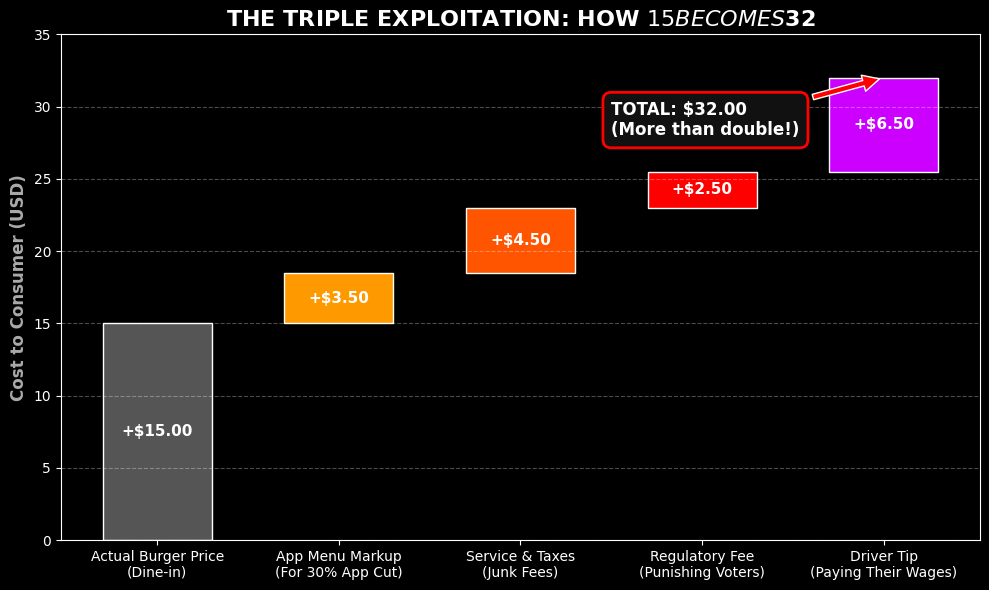
- The Menu Markup: To survive the 30% commission charged by UberEats and DoorDash, restaurants secretly inflate their app menu prices by 20-25%. You are paying a hidden tax before you even see the **Delivery App Junk Fees**.
- The Regulatory Punishment: When cities pass laws guaranteeing minimum wages for drivers, apps introduce a “Regulatory Response Fee.” They force the consumer to pay for the regulation, shielding their own profits.
- The Ad-Tech Pivot: Uber and DoorDash are no longer delivery companies. They are digital advertising monopolies that extort restaurants to pay for visibility.
You are tired after a long day of work. You open your phone, select a $15 burger, and proceed to checkout.
Suddenly, the total is $32.00.
There is a delivery fee. A service fee. Taxes. A “Regulatory Response Fee.” And finally, a prompt making you feel guilty if you don’t tip the driver 20%.
You have just stepped into the “Triple Exploitation Matrix.” In this file, we expose the dark economics of **Delivery App Junk Fees** and how Uber and DoorDash turned a money-losing delivery business into a highly profitable digital tollbooth.
The Menu Inflation: The Secret 30% Tax
The scam begins before you even reach the checkout screen.
If you walk into your local diner, that burger costs $15. But on the app, it is listed at $18.50. Why? Because the platforms charge restaurant owners a brutal 30% commission on every order.
Restaurants operate on razor-thin margins (usually 5-10%). To avoid bankruptcy, they have no choice but to pass that 30% commission onto you by inflating the menu price. This means the base price of your food is already a lie.
The Junk Fee Swamp & Regulatory Punishment
Once you hit checkout, the true **Delivery App Junk Fees** appear.
The “Regulatory Response” Scam
Recently, cities like New York and Seattle passed laws requiring delivery apps to pay their drivers a guaranteed minimum wage. How did the billion-dollar platforms respond?
They didn’t take it out of their profits. They created a brand new fee called the “Regulatory Response Fee” and slapped it on the consumer’s bill. It is a punitive measure designed to make voters angry at the government, while the platform keeps its margins intact.
The Tip Shift: Subsidizing Billionaires
Despite charging you $10 in various fees, the platform often pays the driver a base fare of just $2. The platform relies on your “Tip” to subsidize the driver’s actual living wage. You are paying the wages that Uber refuses to pay.
The Ad-Tech Extortion: Why Wall Street Loves Them
For years, Wall Street laughed at Uber and DoorDash, saying food delivery was a cash-burning machine. But recently, they turned highly profitable. How?
They became Advertising Companies.
When you open the app, the first restaurants you see aren’t the best ones they are the ones paying the highest advertising fees to the platform. Restaurants are now forced to pay “bribes” (ad spend) just to be visible to customers in their own neighborhood.
The restaurant loses margin. The driver makes minimum wage. The consumer is drained by **Delivery App Junk Fees**. The only winner is the platform.
📊 Investment Analysis: The Digital Landlords
| Ticker | Company | The Logic |
|---|---|---|
| $UBER | Uber Technologies | They successfully transitioned from a cash-burning transport app to a high-margin advertising network. Inflation helps them, as their 30% cut grows when food prices rise. |
| $DASH | DoorDash | Dominates the US suburbs. Their structural monopoly allows them to dictate terms to local mom-and-pop restaurants. |
DELETE THE APP
The convenience of delivery is a trap. You are funding a digital landlord that produces no food and drives no cars.
The next time you are hungry, put on your shoes, walk to the restaurant, and pay them directly in cash. And if you want the real profits, buy the stock ($UBER).
Disclaimer: The content provided in this article is for informational purposes only. The author is not a licensed financial advisor. This is a structural analysis of the gig economy and platform monopolies.