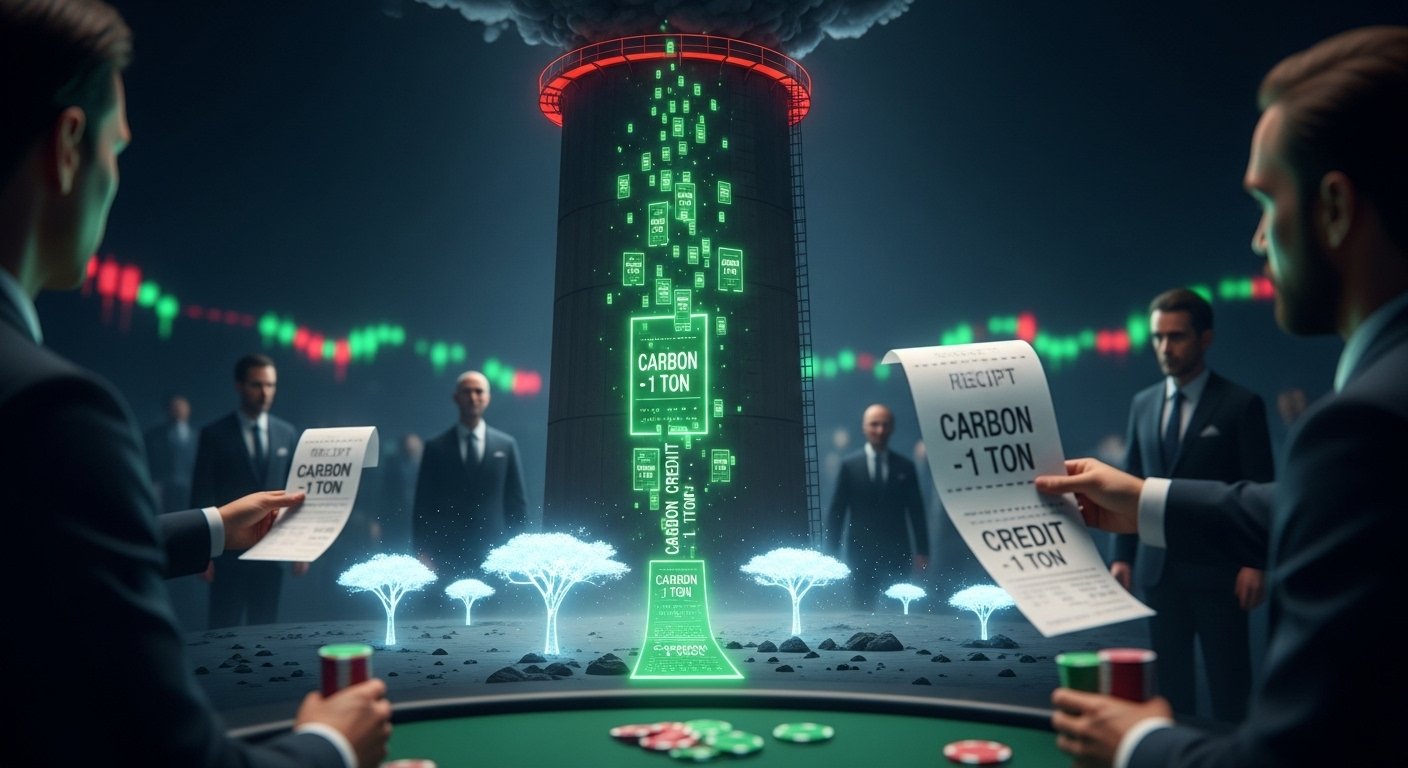
The Carbon Credit Market Scam 2026 has been factually exposed as a sophisticated financial “Indulgence” system. In 2026, major global polluters continue to utilize “Phantom Forests” to achieve their Net Zero goals on paper, avoiding the necessary but costly operational innovations. This guide factually analyzes the Verra certification scandal, the multi-billion dollar “Wall Street Cartel” profit model, and the forced regulatory shift toward high-quality “Carbon Removal” technologies.
The Modern Indulgence: Carbon Credit Market Scam 2026
In 2026, the global corporate response to climate change has been factually divided into two categories: real innovation or the Carbon Credit Market Scam 2026. Major corporations—including Delta Air Lines, Google, and Disney—utilize carbon “offsets” to claim carbon neutrality while maintaining or even increasing their core emissions (e.g., jet fuel combustion, data center power). This is the “Modern Indulgence,” where corporations pay a minimal “fee” (often less than $5 per ton) to buy the “right to pollute,” essentially outsourcing their environmental responsibility to developing nations’ forests that are factually over-credited.
Fact Check 1: The Economics of Phantom Forests
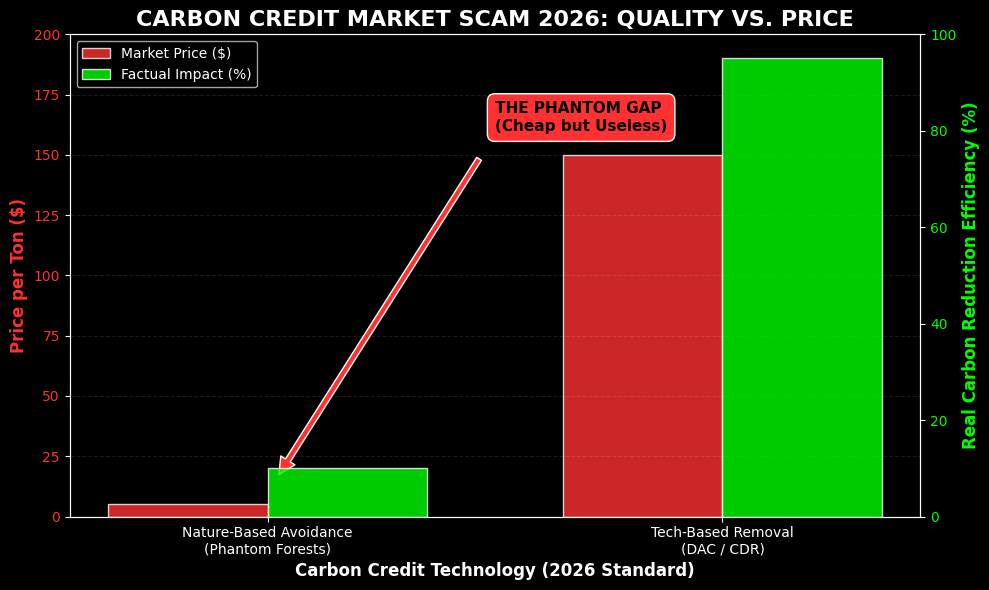
The core asset of the Carbon Credit Market Scam 2026 is the “Phantom Forest”—a nature-based carbon reduction project that exists primarily in digital ledgers. The factual collapse of this market began with the 2024 Verra scandal, where an investigation revealed that over 90% of the tropical rainforest protection credits approved by the world’s leading certifier were factually “ghost credits.” These projects grossly exaggerated the risk of deforestation (a metric known as Additionality), creating millions of dollars in “Phantom” carbon reductions that were sold to unsuspecting consumers and shareholders.
Fact Check 2: Who Profits from the Carbon Credit Market Scam 2026?
The Carbon Credit Market Scam 2026 is not an environmental market; it is a financial derivative “Casino” designed by Wall Street. Factual data shows that less than 10% of the capital invested in nature-based carbon credits ever reaches the local indigenous communities actually protecting the forests. The remaining 90% is extracted as “fees” by project developers in Switzerland, certifiers in Washington D.C., and high-frequency traders in New York and London.
📊 2026 Factual Value Extraction in Nature-Based Credits
| Stakeholder | Role | Factual Revenue Share (%) |
|---|---|---|
| Indigenous Communities | Actual Forest Protection | < 10% (The Remainder) |
| Project Developers | Creation and Marketing | 40% – 60% (High Fees) |
| Wall Street Middlemen | Trading & Derivative Creation | 20% – 30% (Volatility Profit) |
Double Counting: The Ledger Inflation Scam
Another layer of the Carbon Credit Market Scam 2026 is “Double Counting.” Due to failures in global carbon accounting systems (e.g., under Article 6 of the Paris Agreement), many countries claim the carbon reduction from a forest project to meet their national goals, while the corporation that purchased the credit also claims the *same* reduction. Factually, the atmosphere sees zero carbon decrease, but two different entities declare victory on their balance sheets.
The 2026 Shift: From “Avoidance” to “Removal”
In 2026, regulators are striking back against the Carbon Credit Market Scam 2026. The European Union’s Green Claims Directive has officially begun banning “carbon neutral” advertisements that rely solely on nature-based “avoidance” credits. Corporations are now factually prohibited from using “Ghost Forests” to claim a net-zero status.
This has caused a massive “Quality Realignment” in the market. Cheap “Avoidance” credits are being delisted and labeled as “toxic assets,” while high-quality Carbon Dioxide Removal (CDR) technologies, such as Direct Air Capture (DAC) and Bioenergy with Carbon Capture and Storage (BECCS), are becoming the new standard. Although CDR costs 30x more per ton, it is factually verifiable and creates a single, permanent carbon reduction that cannot be “double counted” or “burned down.”
Step-by-Step Guide to Auditing Corporate “Green Claims”
Managing your digital asset portfolio and consumer choices in 2026 requires a factual filter for greenwashing. Follow these steps to identify the Carbon Credit Market Scam 2026 in any corporate “Net Zero” claim:
- Request the “Emissions-to-Offset” Ratio: Factually verify what percentage of the “Net Zero” claim is achieved through physical emissions reductions vs. purchased credits. A ratio of < 50% physical reduction is a primary indicator of a Carbon Credit Market Scam 2026 approach.
- Audit the “Credit Type”: Review the corporation’s ESG report. If they are utilizing “REDD+” (Reducing Emissions from Deforestation and Forest Degradation) credits for more than 20% of their offsets, they are exposed to the “Verra Scandal” risk and “Phantom Forest” assets.
- Check for independent Verification: Has the carbon credit been verified by a second, independent “Quality Auditor” (e.g., BeZero Carbon, Sylvera) beyond the primary certifier? In 2026, primary certifiers are factually compromised.
- Scan for “Carbon Removal” Investment: Is the company factually investing in DAC, BECCS, or advanced CDR technologies (>$100/ton), or are they only buying $5/ton avoidance credits? Real innovation requires real capital.
Frequently Asked Questions About the 2026 Carbon Scam
Is “Net Zero” factually a lie?
“Net Zero” as a concept is mathematically sound: Total Emissions – Total Removals = 0. However, the Carbon Credit Market Scam 2026 exploits the “Removals” part by replacing actual *Carbon Removal* with hypothetical *Emission Avoidance*. When a company claims net zero without physically capturing and storing carbon, it is a factual, greenwashing-based accounting lie.
Are all nature-based carbon credits a scam in 2026?
No. Highly localized, well-monitored afforestation (planting new forests) and soil carbon sequestration projects are factually beneficial. However, they represent less than 5% of the total nature-based market. The remaining 95%, based on “Avoiding Deforestation” through hypothetical dynamic baselines, is what constitutes the Carbon Credit Market Scam 2026.
Verification Checklist for Your Ethical Portfolio
Before buying products labeled “Carbon Neutral” or investing in ESG funds, personally verify these factual items to protect your assets from the Carbon Credit Market Scam 2026:
- [ ] Scope 3 Emissions Factual: Does the company include Scope 3 (Supply Chain) emissions in their “Net Zero” goal, or just Scope 1 & 2? (Excluding Scope 3 is a major red flag).
- [ ] CDR Investment Factual: Does the company have a publicized contract with a Direct Air Capture facility (e.g., Climeworks, 1PointFive)?
- [ ] Offset Price Factual: If the company claims “Carbon Neutrality” for an entire product line but the product price remains unchanged, they are factually utilizing cheap, $5/ton phantom credits.
- [ ] Double Counting Factual: Does the specific credit they bought use a “Corresponding Adjustment” on the national ledger? (If not, it’s double-counted).
The Planet Gets Hotter, the Books Get Cleaner: Next Steps
Securing your financial and environmental future in 2026 means recognizing when “Green” has been weaponized into “Rents.” The Carbon Credit Market Scam 2026 is a factual system that allows pollution to continue under the guise of an accounting trick. True capitalist solutions require real, physically verifiable innovation—like Tesla’s electric vehicle revolution or the direct capture and storage of carbon—not numerical manipulation on a spreadsheet. It is highly recommended to audit your “Green” expenditures and support companies that invest in physical Carbon Removal, not financial smoke-and-mirrors. For more factual data on carbon accounting, visit the official GHG Protocol (ghgprotocol.org) or the EU Green Claims portal.