
📄 Detective’s Briefing: The Resume Black Hole
- The 43% Illusion: The **Ghost Jobs LinkedIn Scam** is real. Recent surveys reveal that up to 43% of current online job postings are fake. Companies have absolutely no intention of hiring anyone.
- Corporate Theater: Why post fake jobs? To trick Wall Street into thinking the company is growing, and to pacify burnt-out employees by pretending “help is on the way.”
- The Microsoft Monopoly: Desperate job seekers, thinking their resumes are the problem, pay $40/month for LinkedIn Premium. Microsoft ($MSFT) is monetizing the desperation created by this broken system.
You spend three hours tailoring your cover letter.
You optimize your resume for the ATS (Applicant Tracking System).
You hit “Apply” on LinkedIn for a job that perfectly matches your skills.
And then… silence. Nothing. Not even an automated rejection email.
You start to doubt yourself. “Am I not good enough? Is my experience lacking?”
Stop blaming yourself. The game is rigged. You are fighting an invisible enemy.
Welcome to the era of the **Ghost Jobs LinkedIn Scam**. In this investigation, we pull back the curtain on “Corporate Theater” and expose how your desperation is generating billions in recurring revenue for Big Tech.
The Corporate Theater: Why Fake Jobs Exist
It sounds irrational. Why would a company spend time and money to post a job if they aren’t going to hire anyone?
It is called Corporate Theater, and it serves two very specific, manipulative purposes.
1. Tricking Wall Street
In the corporate world, “hiring” equals “growth.” If a company removes all its job postings, investors might panic and think the company is struggling or preparing for mass layoffs. By keeping dozens of “Ghost Jobs” open on their career pages, executives create the illusion of a healthy, expanding business. It is a cheap marketing trick to protect their stock price.
2. The Internal Pacifier
After a round of layoffs, the remaining employees are forced to do the jobs of three people. They work 80 hours a week and are on the verge of burnout.
Management points to the active job postings on LinkedIn and says: “Hold on a little longer! We are actively interviewing for your team. Help is coming!”
Help is not coming. The job posting is a placebo meant to stop employees from quitting.
The Premium Trap: Monetizing Desperation
The **Ghost Jobs LinkedIn Scam** is cruel, but it is also an incredibly lucrative business model for the platform hosting it.
When you apply to 100 jobs and hear nothing back, fear sets in.
LinkedIn offers you a solution: LinkedIn Premium.
For roughly $40 a month, they promise to show you how you rank against other applicants. They promise to give you direct messaging access (InMail) to recruiters. They sell you the “edge” you need to beat the competition.
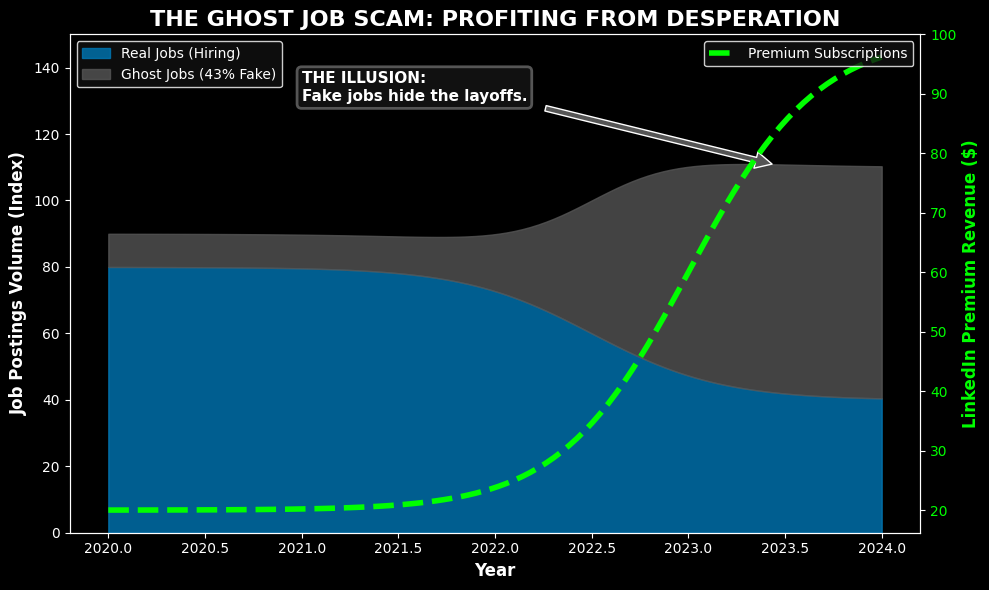
But here is the dark truth: You are paying $40 a month to get analytics on a job that doesn’t exist. You are using your paid InMail credits to message a recruiter who was fired three months ago.
The longer the job market stays frozen, the longer you stay subscribed. Desperation is the ultimate customer retention strategy.
The Detective’s Verdict: The Unbreakable Moat
It is easy to hate the system, but as an investor, you have to admire the ruthless efficiency of the moat.
📊 Investment Analysis: The Architect of the Scam
| Ticker | Company | The Logic |
|---|---|---|
| $MSFT | Microsoft | They own LinkedIn. In a booming economy, companies pay them for recruiter tools. In a bad economy, desperate candidates pay them for Premium. It is a “heads I win, tails you lose” monopoly. |
DON’T FIGHT GHOSTS
The next time you get rejected, don’t immediately rewrite your resume. Understand that you are participating in the **Ghost Jobs LinkedIn Scam**.
Stop blindly applying to postings older than 14 days. Network directly with humans. And if you want to profit from this broken system, buy shares in the company collecting the toll ($MSFT).
Disclaimer: The content provided in this article is for informational purposes only. The author is not a licensed financial advisor. This is a structural analysis of the labor market and tech platform business models.