📱 Detective’s Briefing: The Screen of Shame
- The Social Trap: The **Guilt Tipping Scam** relies on “Social Monitoring.” Cornell University proved that spinning an iPad screen around forces customers to tip 11% more often due to social pressure.
- The Hidden Winner: You blame the barista, but the real winners are Fintech companies like **Block (Square)** and **Toast**. Their 2.9% fee is charged on the *total* amount, including the tip and tax.
- The Regulatory Risk: “Tip Fatigue” is peaking. As laws like California’s SB 478 ban junk fees and deceptive pricing, these Fintech giants face a massive threat to their profit margins.
You walk into a coffee shop, grab a bottle of water from the fridge, and walk to the counter.
The cashier scans the bottle. No greeting. No service.
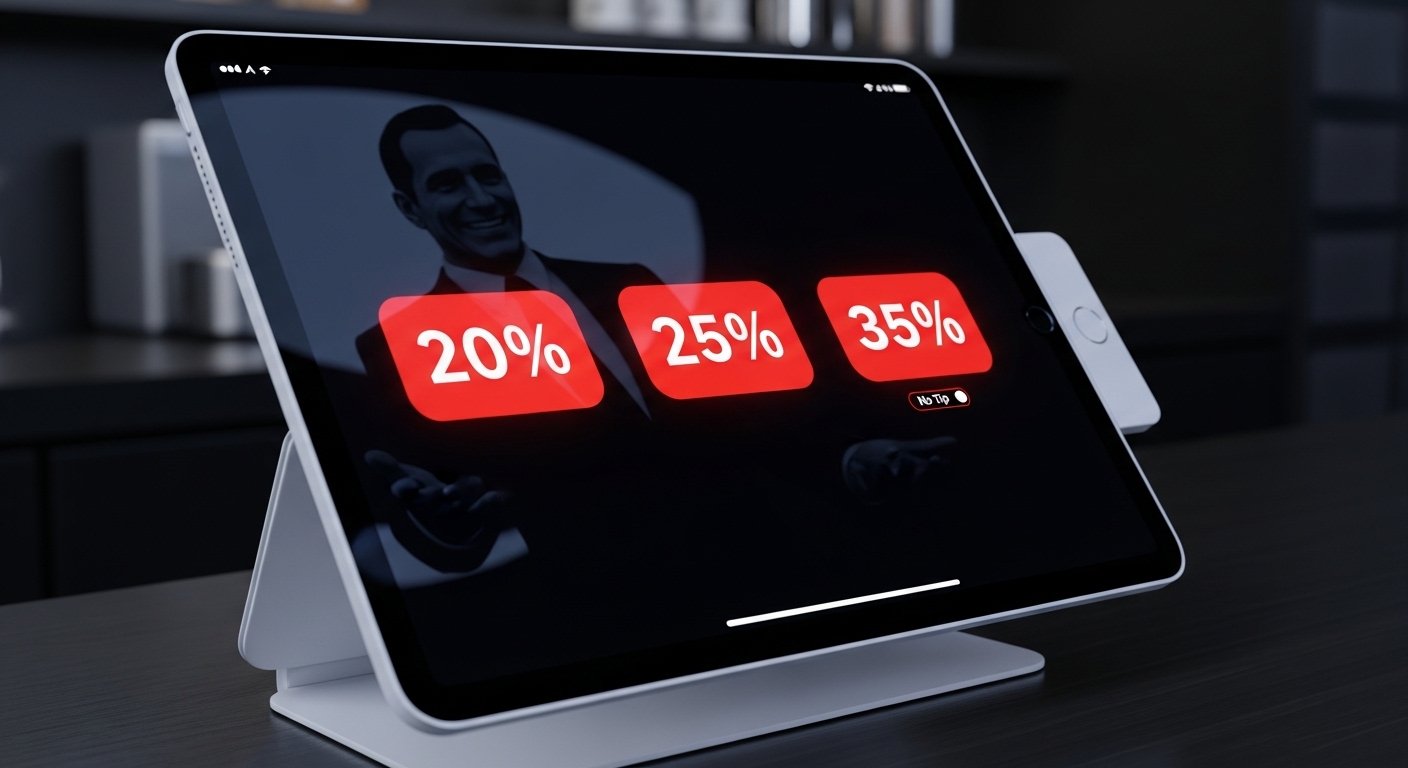
Then, they spin the iPad around to face you.
It stares at you with three massive buttons: 20%, 25%, 30%.
The “No Tip” button is tiny, hidden at the bottom, practically begging you to feel like a terrible person if you press it.
The barista is watching. The person in line behind you is watching.
You panic. You press 20%.
You have just fallen for the **Guilt Tipping Scam**. In this investigation, we expose how this psychological warfare was designed not by struggling café owners, but by billion-dollar Silicon Valley algorithms.
The Psychology: Weaponizing “Social Monitoring”
Why does the iPad screen feel so much more aggressive than an old-fashioned tip jar?
According to a study by Michael Lynn, a professor of consumer behavior at Cornell University, it comes down to a concept called “Social Monitoring.”
The Trap of the Swivel Screen
In the past, you signed a paper receipt. It was private. The waiter walked away.
Today, the physical act of the cashier flipping the screen creates an immediate, high-pressure social interaction. The software is designed to exploit your fear of being judged. The data shows this simple UI change increases the probability of a customer leaving a tip by over 11%.
The **Guilt Tipping Scam** is a masterclass in behavioral economics.
The Fintech Trick: Who Really Gets the Money?
When you get mad at “Tipflation,” you probably blame the greedy business owner. But let’s follow the money.
The Point-of-Sale (POS) systems are provided by Fintech giants like Block (formerly Square) and Toast.
How do they make money? They charge a processing fee—usually around 2.9% + 30 cents per swipe.
The GPV Multiplier
Here is the brilliant, evil trick.
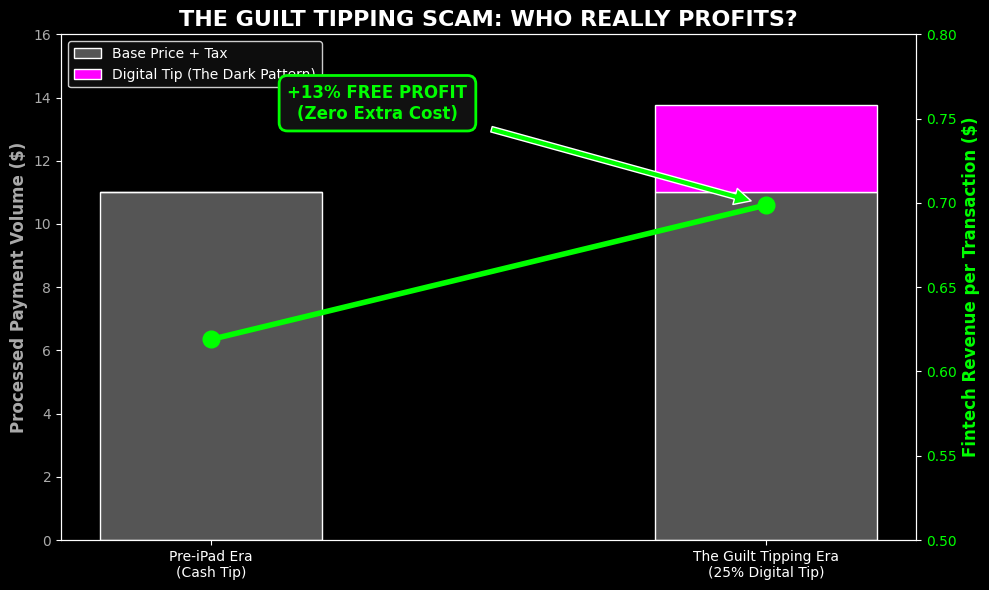
They do not charge their 2.9% fee on the price of the coffee. They charge it on the Gross Payment Volume (GPV), which means the Coffee + Tax + Tip.
If they use software “Dark Patterns” to nudge the default tip from 15% to 25%, the total transaction size grows. Square and Toast get a massive, immediate boost in their revenue without lifting a finger, building a new factory, or offering a new product. They literally weaponized your guilt into free corporate revenue.
The Detective’s Verdict: The Bubble is Bursting
The **Guilt Tipping Scam** has reached a breaking point. Consumers are exhausted. “Tip Fatigue” is trending across social media, and lawmakers are noticing.
📊 Investment Analysis: The Payments Duopoly
| Ticker | Company | The Regulatory Risk |
|---|---|---|
| $SQ | Block (Square) | Heavy reliance on small business GPV. If consumers rebel against tipping, total transaction sizes will shrink, compressing Square’s margins. |
| $TOST | Toast | Dominates the restaurant space. Highly exposed to California’s SB 478 (Junk Fee Ban). If dark patterns are regulated, Toast bleeds. |
PRESS “CUSTOM AMOUNT”
The next time the iPad spins around, remember: the machine is designed to make you feel bad. It is a psychological algorithm.
Take a breath, press “Custom Amount,” and pay for the service you actually received, not the service the algorithm demands.