Investors constantly seek strategies to maximize returns while minimizing tax liabilities. A powerful, yet often misunderstood, tool in this pursuit is the federal Opportunity Zones program. Created to spur long-term private investment in economically distressed communities across the country, Opportunity Zones offer significant tax incentives for reinvesting capital gains. This guide provides a deep dive into how these zones work, the powerful benefits they offer, and their impact on community development.
For investors, this program provides a unique pathway to defer, reduce, and potentially eliminate taxes on capital gains. For communities, it represents a vital source of private sector funding for projects that can create jobs and stimulate lasting economic growth. Understanding the mechanics of Opportunity Zones is the key to unlocking this dual potential.
Table of Contents
Defining Opportunity Zones and Qualified Opportunity Funds
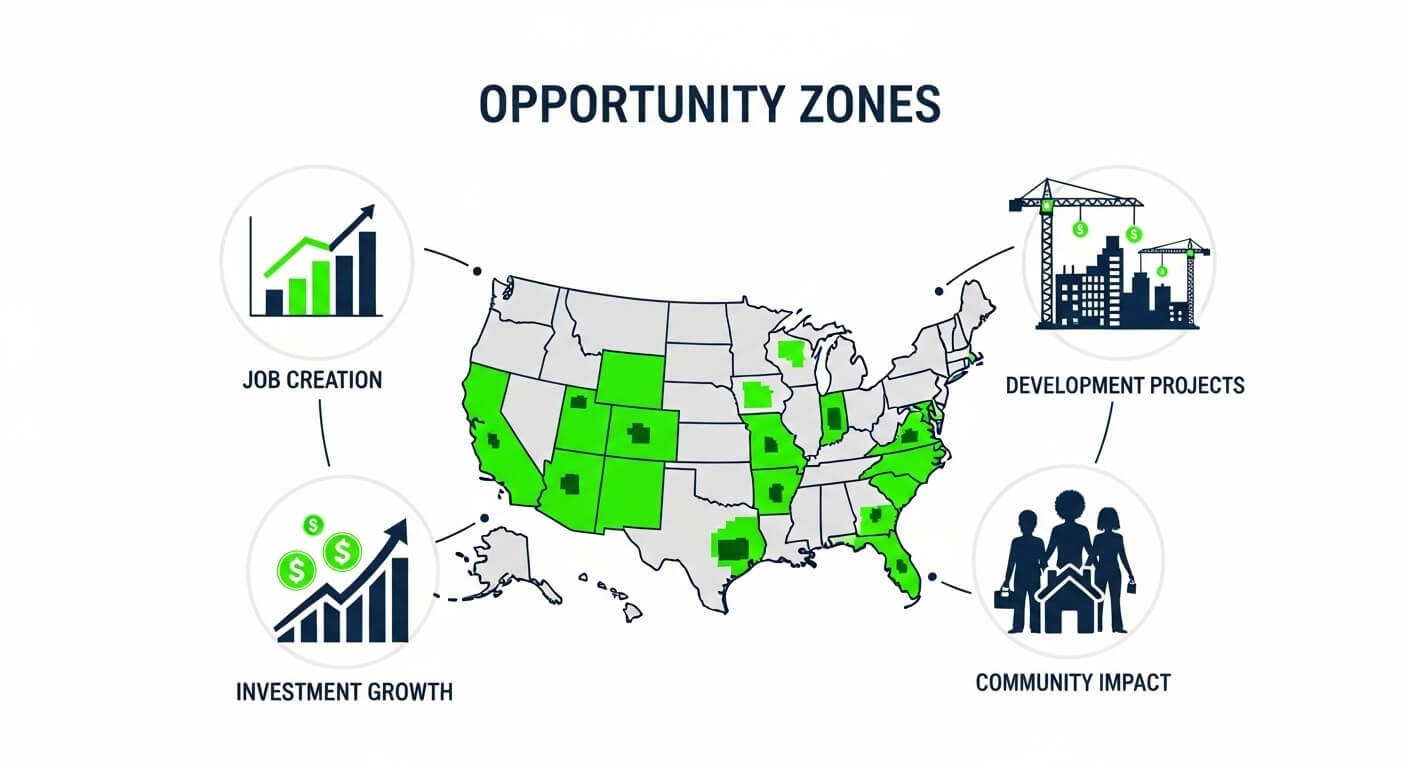
Established by the Tax Cuts and Jobs Act of 2017, the Opportunity Zones program is an economic development tool. It allows governors to designate certain low-income census tracts as Qualified Opportunity Zones (QOZs). The core objective is to move beyond traditional government funding by encouraging private investors to put their capital to work in these areas.
To participate, investors must place their capital gains into a Qualified Opportunity Fund (QOF). This is a dedicated investment vehicle, structured as a partnership or corporation, that is required to hold at least 90% of its assets in eligible QOZ property. This property can be stock in an Opportunity Zone business, a partnership interest, or tangible property like real estate.
- [External Link] The U.S. Department of the Treasury has certified over 8,700 census tracts as QOZs. An official, interactive map is available on the U.S. Department of Housing and Urban Development (HUD) website: HUD Opportunity Zones Map.
The Three Core Tax Incentives for Investors
The immense appeal of the Opportunity Zones program stems from its three-tiered structure of tax benefits, which work together to reward patient, long-term investment.
1. Temporary Tax Deferral
An investor who realizes a capital gain from any source (e.g., selling stock or real estate) can defer paying taxes on that gain by reinvesting it into a QOF within 180 days. The tax payment on the original gain is deferred until the investor sells their QOF interest or until December 31, 2026, whichever comes first.
- Example: An investor sells shares in May for a $100,000 capital gain. By reinvesting that $100,000 into a QOF before the 180-day deadline, they defer paying the associated capital gains tax for the current year.
2. Basis Step-Up (Reduction of Taxable Gain)
Note: This benefit’s deadlines have passed for new investments but are crucial for understanding the program’s initial structure. The program offered a “step-up” in basis for long-term holds. An investment held for 5 years received a 10% basis increase, and one held for 7 years received an additional 5% increase, effectively reducing the original taxable gain.
3. Permanent Tax Exclusion on QOF Growth
This is the most significant and powerful benefit of the Opportunity Zones program. If an investor holds their QOF investment for a minimum of 10 years, the capital gains realized from the appreciation of the QOF investment itself are 100% tax-free.
- Example: Continuing the scenario above, the investor’s $100,000 QOF investment grows to $350,000 over a 10-year period. When they sell their interest in the fund, the $250,000 of appreciation ($350,000 – $100,000) is completely exempt from federal capital gains taxes. This feature dramatically enhances the after-tax return potential.
Impact in Practice: Opportunity Zones in Rural Areas
While Opportunity Zones exist in both urban and rural settings, their impact can be particularly transformative in non-metropolitan areas that have historically struggled to attract investment capital.
Fueling Business Growth and Innovation
In many rural communities, promising businesses lack the equity funding needed to scale. QOFs can fill this gap by providing patient capital to support expansion.
- Example: A QOF invests in an AgriTech startup located in a rural California QOZ. The funding allows the company to build a new research facility and hire local engineers and scientists to develop innovative crop-monitoring technology. This not only creates high-skilled jobs but also fosters an ecosystem of innovation.
Revitalizing Infrastructure and Real Estate
QOF capital is frequently used for real estate development, including commercial, residential, and industrial projects that can revitalize a community’s core.
- Example: In a designated Opportunity Zone in a small town in North Carolina, a QOF finances the redevelopment of an abandoned textile mill into a mixed-use complex with apartments, artisan workshops, and a restaurant. This project preserves a historic building, creates housing, and establishes a new destination for commerce and tourism.
How to Navigate the Investment Process
Engaging with the Opportunity Zones program requires careful adherence to IRS regulations.
- Generate a Capital Gain: The process starts with the sale or exchange of an asset that results in a capital gain.
- Reinvest in a QOF: The investor has 180 days from the date of the sale to reinvest the gain into a Qualified Opportunity Fund.
- Hold the Investment: The QOF uses the capital for eligible projects. To receive the full tax-free appreciation benefit, the investor must remain in the fund for at least 10 years.
- [External Link] For detailed guidance, the Internal Revenue Service (IRS) provides a comprehensive list of frequently asked questions that covers technical specifics for investors and fund managers: IRS Opportunity Zones FAQ.
Conclusion: A Strategic Tool for Investors and Communities
The Opportunity Zones program offers a compelling, tax-efficient framework for reinvesting capital gains. By aligning the financial interests of investors with the economic needs of underserved communities, it creates a powerful incentive for long-term growth. For investors, it is a strategic tool to build wealth while deferring tax obligations. For communities, it is a vital mechanism to attract the private capital needed to build a more prosperous and resilient future.