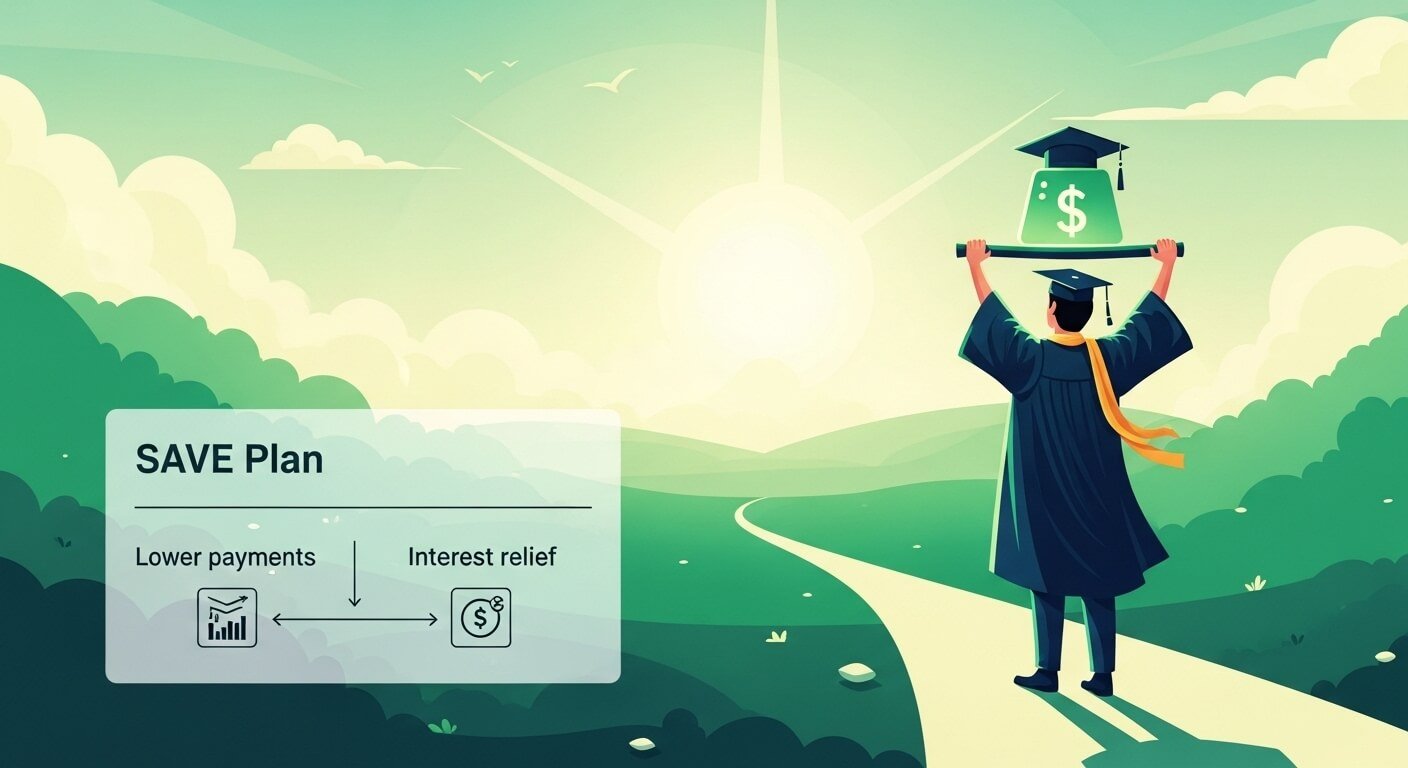
Tired of the Student Loan Grind? Discover how the SAVE plan could significantly lower your monthly payments and help you achieve financial freedom faster.
It seems like a huge percentage of my generation is dealing with the same problem: student loans. It’s a weight on our shoulders that just won’t seem to go away. Seriously, a lot of us feel like we’re constantly on a treadmill, running but never getting ahead because of these payments. What if I told you there’s a new plan that could actually change the game for you? The Biden administration’s new SAVE plan, which stands for Saving on a Valuable Education, is designed to significantly reduce the financial burden for millions of borrowers. It’s a big deal, and it’s something you should definitely know about. 😊
What is the SAVE Plan and How Does It Work? 🤔
The SAVE plan is an income-driven repayment (IDR) plan that replaces the existing Revised Pay As You Earn (REPAYE) plan. It’s built to be more flexible and, for most borrowers, more affordable. The plan calculates your monthly payment based on your income and family size, rather than your loan balance. This is a game-changer because it means your payments adjust to what you can realistically afford, not to a fixed number that might be impossible to meet.
A key feature of the SAVE plan is its new payment formula. Previously, the formula was based on 10% of your discretionary income. The new formula reduces this to just 5% for undergraduate loans. This single change can cut your monthly payments in half. If you have a mix of undergraduate and graduate loans, your payment will be a weighted average of 5% and 10% of your discretionary income. The federal government also plans to stop charging you interest that isn’t covered by your monthly payment, so your loan balance won’t grow as long as you make your payments, even if the payment is $0.
💡 Important Note!
Under the SAVE plan, your discretionary income is calculated differently than under other IDR plans. It’s based on the difference between your adjusted gross income (AGI) and 225% of the federal poverty line, which is a big increase from the previous 150%. This change means that many borrowers with lower incomes will have a $0 monthly payment.
Who is Eligible for the SAVE Plan? 📊
Most federal student loan borrowers are eligible for the SAVE plan. This includes borrowers with loans from the Federal Family Education Loan (FFEL) Program and Perkins Loans, as long as they are consolidated into a Direct Consolidation Loan. It’s a pretty broad eligibility, which is fantastic news for a lot of people.
However, there are a few types of loans that are not eligible, such as Parent PLUS loans. It’s always a good idea to check your specific loan types before you apply. Remember, even if you’re currently on a different IDR plan, you can switch to the SAVE plan to take advantage of its benefits.
SAVE Plan vs. Other IDR Plans
| Aspect | SAVE Plan | REPAYE Plan | Other IDR Plans |
|---|---|---|---|
| Monthly Payment | 5-10% of discretionary income | 10% of discretionary income | 10-20% of discretionary income |
| Interest Subsidies | 100% of unpaid interest is subsidized | 50% of unpaid interest is subsidized | No interest subsidy |
| Poverty Line Calculation | 225% of federal poverty line | 150% of federal poverty line | 150% of federal poverty line |
| Loan Forgiveness | 10-25 years of payments | 20-25 years of payments | 20-25 years of payments |
⚠️ Warning!
Be careful with loan consolidation. While it makes most loans eligible for SAVE, it can reset your payment count for loan forgiveness. If you’re close to having your loans forgiven under a different plan, this might not be the best option for you.
Applying for the SAVE Plan: Step-by-Step Guide 🧮
So, you’re ready to apply? The process is pretty simple, and you can do it all online. Here’s how you can get started:
- Step 1: Gather Your Information. You’ll need your FSA ID, your most recent tax return or other income documentation, and your spouse’s income info if you’re married and filing jointly.
- Step 2: Visit the Official StudentAid.gov Website. Go directly to the Federal Student Aid website and navigate to the “Income-Driven Repayment Plan Request” page.
- Step 3: Complete the Application. The online application is super user-friendly. Just follow the prompts, enter your information, and be sure to select the “SAVE” plan.
- Step 4: Wait for Confirmation. After you submit, you’ll receive a confirmation. Your servicer will then process the request and update your payment information.
📝 Calculation Example: How Much Could You Save?
Let’s do a quick calculation to see the potential savings.
SAVE Payment = (Your AGI – 225% of FPL) x 5% (for undergraduate loans)
For example, let’s say your AGI is $45,000 and the federal poverty line (FPL) for your family size is $15,000. Under the old rules (150% of FPL), your discretionary income would be $22,500. At 10%, your payment would be about $187/month. Under the new SAVE plan, your discretionary income is only $11,250 (AGI – 225% FPL), so your payment at 5% is just $47/month. That’s a huge difference!
Key Benefits You Don’t Want to Miss 👩💼👨💻
The SAVE plan offers some serious advantages beyond just a lower payment. One of the biggest is the interest subsidy. If your calculated monthly payment is less than the interest that accrues on your loans each month, the government pays the difference. This means your loan balance won’t grow over time due to unpaid interest. This is a game-changer! It removes a major source of stress for borrowers who felt like they were in a debt spiral.
Additionally, the plan offers faster loan forgiveness for certain borrowers. If your original loan balance was $12,000 or less, you can have your remaining balance forgiven after just 10 years of payments, instead of the standard 20 or 25 years. This benefit is a big motivator for many borrowers to stay on track with their payments.
📌 Important to remember!
You must reapply for the SAVE plan annually. The government will send you a reminder, but it’s a good idea to set a personal calendar reminder so you don’t miss the deadline and your payments don’t revert to a higher amount.
Final Thoughts: Is the SAVE Plan Right for You? 📝
Honestly, the SAVE plan is one of the most significant changes to student loan repayment in a long time. For many borrowers, it’s a clear path to lower payments and, eventually, a debt-free life. I mean, who doesn’t want that?
Whether you’re struggling with high payments or just want to take advantage of the interest subsidy, it’s worth exploring. It’s not a magic bullet, but it offers a realistic, sustainable way forward. If you have any questions or want to share your own experience, leave a comment below! 😊
Key Takeaways from the SAVE Plan
✨ Lower Payments: Monthly payments are reduced to just 5% of discretionary income for undergraduate loans.
📊 Interest Subsidy: The government pays any interest not covered by your monthly payment, preventing your balance from growing.
🧮 How Payments Are Calculated:
👩💻 Faster Forgiveness: For balances of $12,000 or less, loans are forgiven after just 10 years of payments.
Frequently Asked Questions ❓